Category: Latest Posts

  • Home sales remain low but recovering slowly, says BCREA

    Home sales remain low but recovering slowly, says BCREA

    The latest BCREA report highlights a cautious but steady recovery in BC’s residential real estate market. In August, residential home sales across British Columbia totaled $5.2 billion, reflecting a 4.8% decrease, while average prices softened by 1% to $924,826. Sales volume also dipped 5.5% to 46,069 homes. In Greater Vancouver, we saw a 1.3% price adjustment and a 3.6% drop in sales. Having advised on over $300 million in transactions throughout my 16 years in Vancouver’s market, I’ve seen cycles like this before—key moments to recalibrate strategies, whether you’re a local family, a newcomer, or an investor. Understanding these shifts is essential for making informed decisions and building long-term value, especially for those navigating both local and cross-border opportunities. As always, I’m here to provide clarity and insights for clients looking to position themselves wisely in today’s evolving landscape.
    Continue to full article

  • Fall 2026 Housing Supply Report

    Fall 2026 Housing Supply Report

    As we look ahead to Fall 2026, Canada’s housing supply story remains complex—especially here in Vancouver. Most major cities are still facing a persistent housing gap, with the notable exceptions of Calgary and Edmonton. We’re seeing that construction activity is tapering off even faster than demand, which could put additional pressure on affordability for both buyers and renters. While rental housing currently leads the way in new supply, the slowdown in condo starts means fewer ownership opportunities coming to market. For those of us advising families and investors—whether local, new to Canada, or coming from abroad—this underscores the importance of staying informed and adaptable. Addressing the supply shortage will require not just more housing starts, but real investment in infrastructure as well. With my experience guiding clients through over $300 million in transactions, I keep a close watch on these trends to help you navigate your options, whether you’re looking to build long-term assets or secure a place to call home.

    Continue to full article

  • Vancouver, Winnipeg Expand Housing with Resilient Flood Zone Plans

    Vancouver, Winnipeg Expand Housing with Resilient Flood Zone Plans

    StatsCan has highlighted that cities like Vancouver and Winnipeg are seeing an increase in new homes being built in high flood hazard areas. In particular, Winnipeg, Vancouver, Chatham-Kent, and Chilliwack have many homes located in these flood-prone zones, with Manitoba, Saskatchewan, and B.C. recording notable recent growth in such areas due to ongoing efforts to address housing supply.

    Having advised on real estate transactions across Greater Vancouver for over 16 years, I always encourage clients—whether local families, new immigrants, or international investors—to look deeper than just supply and demand. Understanding site-specific risks, such as flood hazard exposure, is essential when making property decisions that will serve you and your family for years to come. With Vancouver’s rapid expansion, asset protection and long-term planning are more important than ever. My approach emphasizes blending market opportunity with careful due diligence—so you can confidently build your future in this dynamic city.

    Continue to full article

  • Canada Housing Could Look Very Different in 2027

    Looking ahead to 2027, the Canadian housing landscape is poised for gradual change. According to CMHC, as incomes and the broader economy strengthen, housing conditions should improve. While home sales are expected to recover, activity may still fall short of the busy pace we saw over the past decade. CREA’s outlook points to modest national price growth, signaling a stabilizing market rather than another period of sharp increases. For buyers, higher inventory and softer demand in certain regions could mean more room to negotiate. In my experience advising Vancouver families and international investors, these shifts offer both opportunities and important considerations for those planning their next move or long-term strategy. As always, understanding the nuances of our evolving market is essential for building resilient real estate portfolios.

  • BC Standing Inventory Reached 6.7K

    BC’s standing inventory has reached 6,700 homes, including 5,500 condos—a figure that covers not just condos, but also townhomes and select multiplex units across the province. When we break it down, Burnaby currently leads the way with 1,210 unsold homes, followed by Vancouver at 1,020, Surrey at 798, and Coquitlam at 620. Richmond sits at 396 units, with Kelowna at 372, Langley Township at 276, New Westminster at 224, and Delta at 211. This spread clearly shows that unsold inventory is not limited to BC’s largest urban centres. Other notable counts: Langford at 188, Esquimalt at 173, City of North Vancouver at 135, Abbotsford at 118, and Chilliwack at 100—bringing the listed cities’ total to 5,840 homes. While some point to studios and one-bed units as the primary source, the province-wide data on size and average price tells a more nuanced story.

    As someone who’s advised on a diverse range of property types and client needs in Greater Vancouver and beyond, I see how important it is to understand the true dynamics behind these numbers—especially for families, new immigrants, and investors planning their next move in BC’s evolving market.

  • National Day for Truth and Reconciliation

    National Day for Truth and Reconciliation honours survivors and raises awareness about their experiences.
    It's a symbol of Canada's commitment to reconciliation with Indigenous communities.
    Wearing orange shirts on this day symbolizes respect for survivors and raises awareness about residential schools.
    May this day inspire a future where every voice is heard, and every spirit is healed.
    Together, we can create a tomorrow filled with hope and endless possibilities.

  • Metro Vancouver and Fraser Valley Sales Soften

    Mid-Q3 has brought a noticeable shift in the Metro Vancouver and Fraser Valley markets. We recorded 1,900 residential sales—a softer outcome for summer 2026, and another month tracking below this year’s earlier forecasts. The composite benchmark price settled at $1.08M, down month-over-month from early Q3, as buyer-friendly conditions continue to take shape across our region. Active inventory climbed to 15,800 properties, giving buyers more selection and supporting a competitive environment among sellers. Detached homes experienced the sharpest price adjustment (benchmark: $1.8M), while apartments reached $686K and attached homes $1.03M. With the sales-to-active listings ratio at roughly 12%, this is distinctly a buyers’ market—ample choice and more room for negotiation.

    With over 16 years advising clients in Vancouver real estate, I’ve seen how these market dynamics create both challenges and strategic opportunities. Whether you’re a local family, a new immigrant, or building cross-border investments, understanding timing and negotiation will be key as we move through these buyer-favored conditions.

  • More Choices for Homebuyers in Metro Vancouver and Fraser Valley

    More Choices for Homebuyers in Metro Vancouver and Fraser Valley

    We’re seeing some significant shifts in Metro Vancouver and Fraser Valley housing as we approach fall. Sales in Metro Vancouver have decreased by 4.6%, with benchmark prices down 5.6% to $1,081,900. Inventory has climbed to 26.2% above average—an environment that gives buyers more leverage and choice. The Fraser Valley is experiencing a similar trend, with sales slowing and prices down 7%, highlighting a clear buyer’s market.

    Having helped families and investors navigate these cycles for over 16 years, I know how important it is to interpret these changes for your unique situation—whether you’re planning a first purchase, considering a move, or looking at long-term investment. For local families and new arrivals alike, understanding what these numbers mean for your goals is key. As always, I’m committed to providing clear insight and guidance, so you can make confident decisions in this evolving market.

    Continue to full article

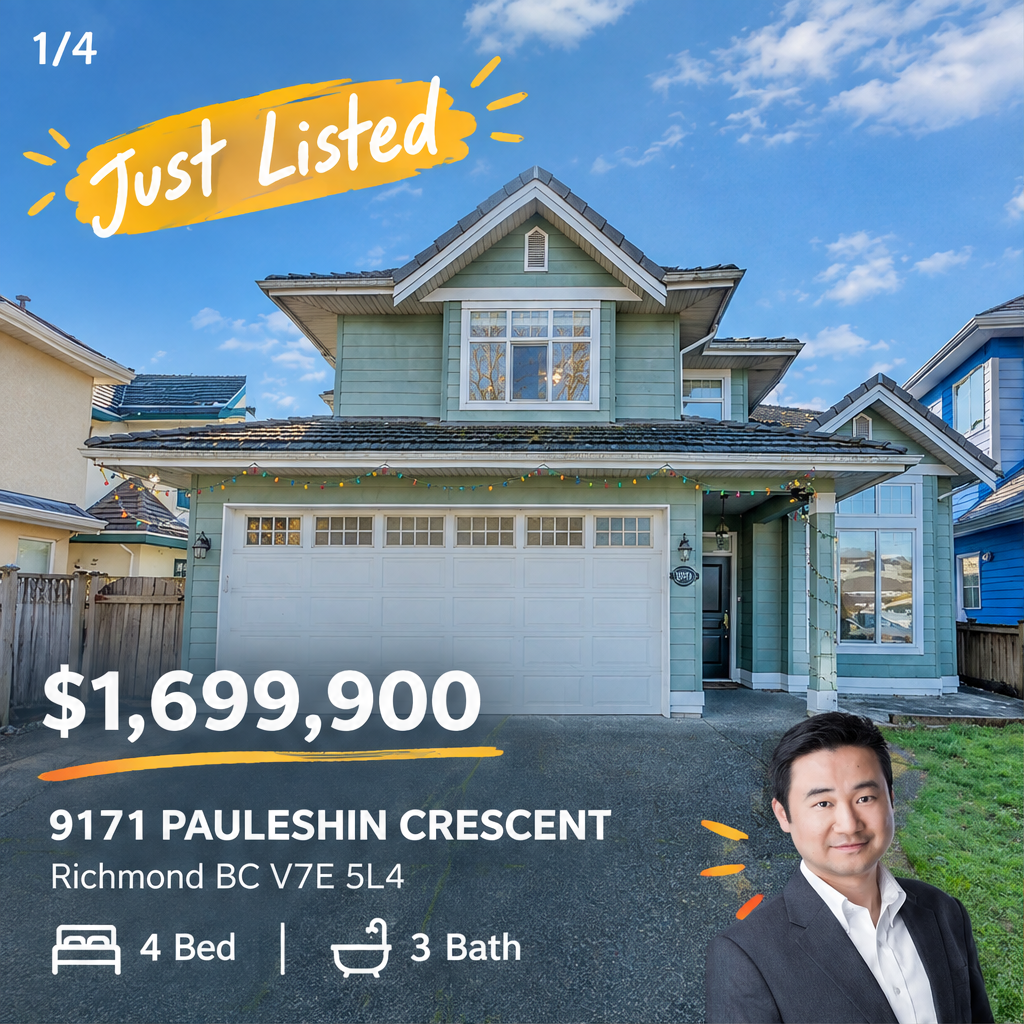
  • 9171 PAULESHIN CRESCENT, Richmond BC V7E 5L4

    9171 PAULESHIN CRESCENT, Richmond BC V7E 5L4

    9171 PAULESHIN CRESCENT, Richmond BC V7E 5L4
    Price: 1699900
    Beds: 4
    Baths: 3
    Home type: House
    Just Listed

    Continue to full article

  • Vancouver Sees New Opportunities Amid 2025 Population Shift

    Vancouver Sees New Opportunities Amid 2025 Population Shift

    Metro Vancouver just recorded its slowest population growth in years, with Vancouver itself seeing a rare drop—over 8,000 residents left between 2024 and 2025, the largest decline in two decades. Federal immigration shifts and rising living costs are at the heart of this trend, creating ripple effects for our housing market and how the city plans its infrastructure. For families, investors, and newcomers, this signals a new chapter in how we approach both real estate opportunities and long-term planning. Having spent 16 years advising clients—especially Chinese families and international investors—on navigating Vancouver’s evolving market, I’ve seen firsthand how population changes shape our neighborhoods and investment strategies. As we adapt to these shifts, a deep understanding of local dynamics and global trends becomes even more essential.

    Continue to full article